Consumer Brand Point-of-Sale Print for Multi-Location Distribution
Quick answer
A multi-location POS rollout means coordinating point-of-sale and point-of-purchase displays across dozens of stores so they arrive on time and get placed correctly. POP displays catch shoppers throughout the store, while POS displays sit at checkout for a final impulse decision — successful rollouts plan production, shipping, and store compliance for both formats together.
Launching a retail campaign across multiple locations will always be a challenge. One store may need a different mix of materials than the other, and different store types might require different designs. Above all, you also need to coordinate between delivery schedules that vary by region.
Each of those factors makes the entire campaign prone to errors such as incorrect materials or late shipments. If not handled properly, there is a risk of an inconsistent customer experience, along with additional costs from reprints and expedited shipping. It's why more consumer brands are moving away from stitching together separate print and distribution vendors and toward partners who handle point-of-sale printing and rollout logistics as one connected process.
This guide breaks down why multi-location rollouts get complicated, the questions worth asking before your next one ships, and how pairing print production with fulfillment under one roof enhances the whole process.
What Is a Point-of-Sale Print?
Point-of-sale (POS) print refers to physical printed materials placed in-store to influence purchase decisions at or near the shelf. Common formats include shelf talkers, wobblers, endcap displays, aisle blades, window graphics, floor decals, hanging signs, checkout displays, and promotional inserts.
Point-of-Sale prints are designed to catch a shopper's attention right at the shelf or counter. This is where most of the buying decision happens. There are different types of point-of-sale prints depending on where in the store you need it to show up:
- Shelf talkers: Small signs attached to the edge of a shelf that highlight prices, promotions, or key product features right where shoppers are looking.
- Wobblers: Similar to shelf talkers but mounted on a flexible strip so they move slightly as people walk by.
- Endcap displays: Displays placed in the busiest areas of a store, such as the end of an aisle, to feature promotions, seasonal products, or new arrivals.
- Aisle blades: Signs that extend into the aisle so it's visible even from far away.
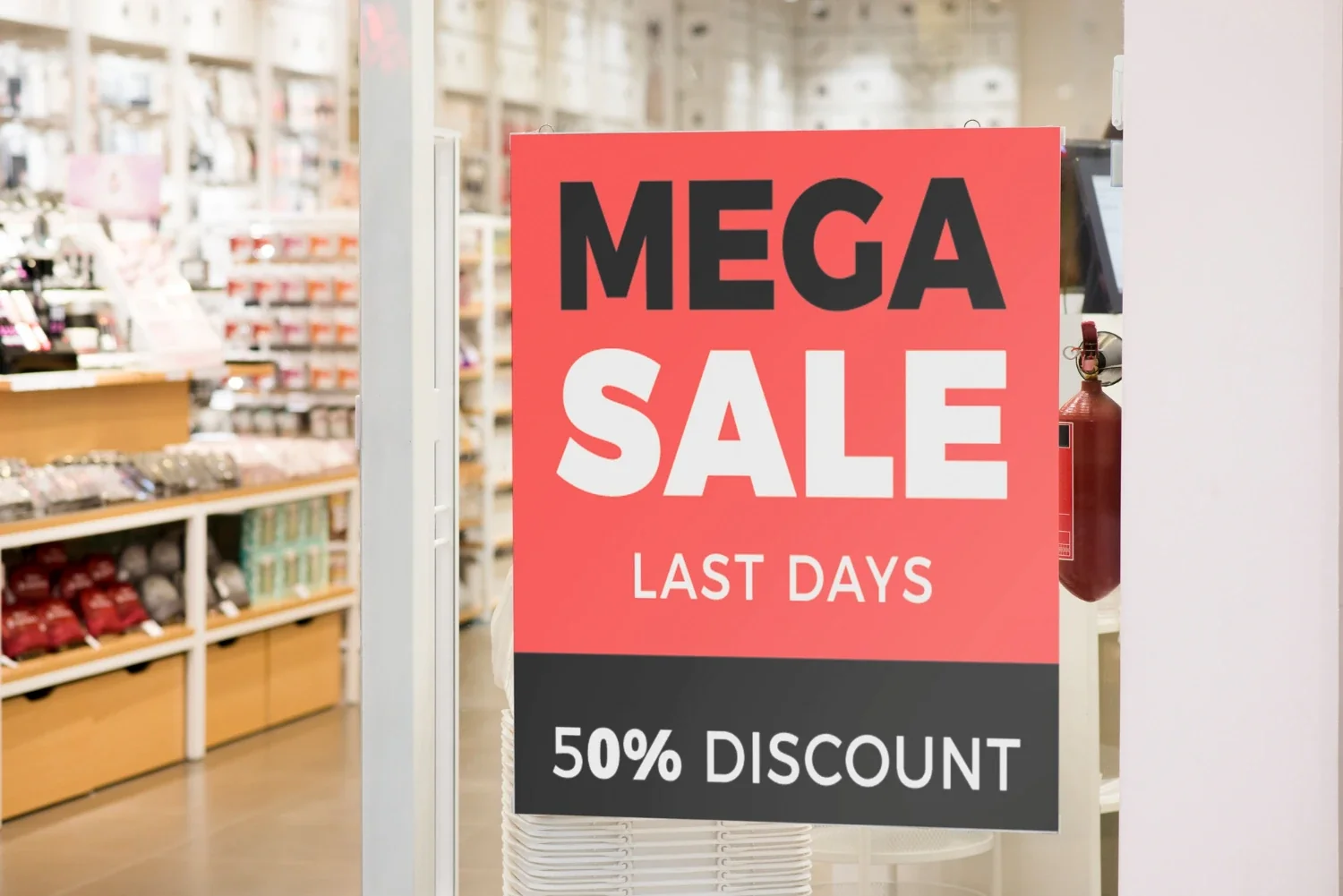
- Window graphics: Vinyl or static-cling graphics applied to storefront windows to promote products, sales, or seasonal campaigns before shoppers even enter the store.
- Floor decals: Graphics placed directly on the floor to guide shoppers toward a display or draw attention to a promotion.
- Hanging signs: Overhead signage that helps shoppers find a department or spot a campaign from across the store.
- Checkout displays: Compact units built for the register area, designed around impulse purchases in the last few feet before a sale closes.
- Promotional inserts: Printed pieces added into packaging, bags, or existing displays to extend a campaign's message past the shelf and into the customer's hands.
Each of these formats solves a different problem, ranging from distance to dwell time to foot traffic. That's also why a multi-location rollout rarely uses just one. Most campaigns lean on a mix, and that mix changes from store to store depending on size and traffic.
It's worth the complexity. Research shows that grocery products supported by both an in-store display and a retailer's promotional feature saw a 129% lift in unit sales compared with features or displays alone. The shelf is still where most purchase decisions happen, which is exactly why a missing display can easily translate into a missed sale.
Why Multi-Location Rollouts Become Complicated
The complexity in a multi-location POS rollout rarely comes from the campaign concept. It comes from the fact that no two stores on your list are actually the same store. In a media plan, "roll out to 200 locations" reads like a single line item. In practice, it's 200 different sets of conditions. Some brands get caught off guard and assume that plans can easily scale cleanly to every location on the list.
However, this does not mean multi-location rollouts are unmanageable; it means they need to be planned as a set of variables rather than identical setups. These are four variables you need to pay more attention to:
-
Store Sizes
A 40,000-square-foot supermarket and a 2,000-square-foot convenience location can't use the same display footprint. The floor standee that works in a big aisle may not fit in a grocery store with a smaller format. That affects more than just the display itself. It changes quantities, packing configurations, and sometimes the entire mix of materials shipped to the store. In this case, quantities have to scale with square footage, not just the store count. -
Regional and Retailer-Specific Promotions
Even when a campaign is designed to happen nationwide, it might still need local variations. Pricing, promotional offers, and required legal language can differ by region or retailer. It still needs multiple versions of the same POS material to match local requirements. Sending the wrong version to a store can create compliance issues, confuse shoppers, and force last-minute replacements. -
Store-level Quantity Requirements
Not every store needs the same number of displays. For example, a large-format location running a full endcap promotion will require more materials than a smaller store with just a checkout display. Quantities should reflect each store's layout, traffic, and merchandising plan instead of sending the same shipment to every location.
These aren't unusual situations because they are part of almost every multi-location rollout. The more stores involved, the more important it is to plan for these differences before production begins. When brands plan for these differences up front, distribution becomes far more predictable. The goal is not to make sure every store looks identical. It's about making sure you get the details right to execute the promotion correctly and avoid delays, reprints, and last-minute issues.
One way brands avoid these issues is by creating store-specific kits instead of shipping the same materials everywhere. Each kit is assembled based on what an individual location actually needs. It might be a single countertop display for a convenience store or a complete set of endcap signage, shelf talkers, and window graphics for a larger retail format.
If you're evaluating this approach, our guide, "What's Included in Professional Kitting and Assembly Services," explains what the process involves and how it helps brands execute campaigns more consistently across multiple locations.
A Quick Gut-Check for Your Next Rollout
Managing a multi-location POS campaign involves more than getting the creatives approved. Even well-designed campaigns can run into problems if materials are packed incorrectly, shipped to the wrong stores, or arrive after the promotion has started.
Before production begins, use this checklist to check if your rollout plan is truly ready.
| Question | Yes | No |
|---|---|---|
| Does each store have its own packing list, or are we using a single standard shipment for everyone? | ||
| Do we have a record of which specific stores received their displays, or only a shipping confirmation from the carrier? | ||
| If a regional grocer's reset date doesn't match the rest of the chain, does our production timeline account for that, or does everyone get the same ship date regardless? | ||
| If pricing or promo copy varies by market, is that tracked during production or in someone's spreadsheet? | ||
| If a display shows up damaged or late at one location, who actually finds out, and how fast? |
There's no expectation that every rollout will go exactly as planned. What matters is having systems in place to anticipate common issues and respond before they affect launch.
If you answered "No" to more than one question, it's worth reviewing the process behind your rollout. Many delays and inconsistencies happen after production, during packing, fulfillment, and distribution. Checking those steps can make a difference and save you from last-minute fixes.
Why This Matters More Than It Looks Like It Should
A lot of shoppers don't decide exactly what they're buying until they're already standing in the aisle of a store. Even when customers arrive with a shopping list, they're still comparing brands, noticing promotions, and making last-minute decisions based on what stands out on the shelf. That's the entire reason POS materials exist. They're one of the last opportunities to capture attention and influence a buying decision before a product ends up in the cart.
That also means the success of a promotion depends on more than good creative. If displays arrive late or are sent to the wrong stores, shoppers never see the campaign the way it was intended. Across a multi-location rollout, those inconsistencies can make it harder to measure campaign performance, increase costs through reprints or expedited shipping, and create an uneven brand experience from one store to the next.
How Roundhouse Handles the Handoff
Printing the display is only one part of the process. Making sure every store receives the right materials, in the right quantity, and on time is just as important.
At Roundhouse, printing, kitting, warehousing, and fulfillment all run out of the same facility in Wisconsin. We're centrally located, which works in our favor for shipping and mailing nationwide. Plus, materials are printed, kitted to match each store's needs, and shipped from one location instead of being passed between different vendors.
Our fulfillment team handles the picking, packing, and kitting itself. We are also equipped with 10,000 square feet of environmentally controlled, pallet-rack storage to hold inventory between production runs and staggered ship dates. Whether you're launching a new product or supporting a seasonal promotion, having a single team accountable for the entire end-to-end process can make a difference.
Need help managing a multi-location POS rollout? Connect with Roundhouse to learn how our print production, kitting, warehousing, and fulfillment services can help get the right materials to the right stores on time and ready for launch.
Frequently Asked Questions: Multi-Location POS Rollouts
-
What's the difference between a POP display and a POS display?
POP (point-of-purchase) refers to any spot in the store where a shopper encounters a product and makes a decision. This can be a shelf, an endcap, or an aisle blade. While a POS (point-of-sale) specifically refers to displays at or near the checkout register, where the transaction itself happens. In practice, most multi-location rollouts use both: POP formats catch attention throughout the store, while POS formats capture the last impulse decision before checkout. -
How much does it cost to run a POS display program across multiple stores?
Cost depends less on the display itself but more on how many variations a rollout actually needs. Budget may vary depending on factors such as store count, material choice, the number of format variations required for different store sizes, and whether pricing or promo copy needs to change by region. -
How far in advance should you order POS materials for a multi-location launch?
There's no single lead time that applies across every rollout. Timelines usually scale with the number of variations the campaign requires, not just the number of stores on the list. You cannot assume that every store will hit the same ship date. A single-format national campaign can move faster than one with regional pricing differences, multiple store-size formats, or staggered reset dates across retailers. The safest approach is to build the timeline around your campaign's most complex requirement.