Creative Packaging Design for Small CPG Brands: What to Look for in a Design Partner
Quick answer
Small CPG brands should choose a packaging design partner that can apply visual identity to physical packaging, handle retail-ready compliance requirements, design with print production in mind, and account for shelf context. The right partner understands that packaging must work as both a brand expression and a practical retail product.
Creative design services for consumer goods product packaging do more than make a product look good. They determine whether a shopper picks it up or walks past it. For small CPG brands, that distinction is everything.
In 2005, P&G coined the term “First Moment of Truth,” which is the 3 to 7 seconds when a shopper notices a product on the shelf and decides if it belongs in their cart. Two decades later, that window didn’t get any wider but even tighter.
You might have the right product and the perfect price point, but if your packaging doesn’t immediately signal that value, none of that reaches the customer. For small CPG brands, packaging is the first sales pitch. Getting it wrong means expensive redesigns, lost conversions you’ll never be able to trace, and shelf equity that takes years to rebuild.
This guide breaks down exactly what to look for in a creative design partner beyond portfolios and pitch decks.
What Should Creative Design Services for CPG Packaging Actually Include?
The term “creative design services” can be used loosely. Some agencies only cover graphic design, others include brand strategy, while a few claim to do it all. But for CPG brands, what you actually need is a partner who understands that good packaging design lives at the intersection of four things: aesthetics, retail compliance, print production, and consumer psychology. Pull any one of those out of the equation, and the whole thing starts to break down.
In practice, that means your design partner should be delivering across four areas:
-
Visual Identity Applied to Physical Form
A good creative design partner knows how to translate your logo, color palette, and typography into different packages. They know how to adapt your brand guidelines into pouches, boxes, bottles, sleeves, and all sorts of packaging without losing consistency. -
Retail-Ready Design Standards
A package that looks great digitally can still fail on the shelf if the fundamentals aren’t accounted for. A serious design partner builds designs that not only look great but also account for barcodes, ingredient panels, net weight placement, and FDA and FTC compliance requirements. -
Print Production Awareness
What renders cleanly on screen doesn’t always survive the print process. Variables like substrates, finishes, bleed margins, and color profiles can dramatically change how a design looks once it’s produced at scale. The right partner has enough production fluency to design for how the package will actually look, both in the printer and in your customer’s hands. -
Shelf Context
For CPG brands, your product will sit next to brands with bigger budgets, more established equity, and shelf real estate they’ve earned over the years. The right creative design partner knows that great packaging design accounts for that environment. It’s built to create contrast, draw the eye, and win attention even on crowded shelves.

How to Choose the Right CPG Packaging Design Partner
You request portfolios, sit through a few calls, review some case studies, and suddenly realize that every agency sounds more or less the same. So instead of another checklist every firm will confidently check off, here are four things worth knowing that most partners won’t bring up themselves.
-
A Strong Design Partner Pushes Back
A good partner will tell you upfront if your creative direction will make you invisible on the shelf. If your entire competitive set uses earthy neutrals and lots of white space, matching that would make standing out impossible.🟢 What to look for: They audit your competitive shelf before recommending any direction. Great creative work starts well before design begins. We’ve explored what that level of creative expertise looks like in practice and why it shapes the success of nearly every project.
🚩 Red flags to watch out for: If they’re more interested in agreeing with you than advising you, they’re more likely just a vendor and not a collaborator.
-
Big Agency Portfolio Doesn’t Always Mean the Right Fit for Your Brand
Hot take: Some of the most impressive packaging agencies in the CPG world are specifically bad choices for small brands.It’s not about their skill or expertise, but most award-winning agencies are just built for large clients. They have layered account structures, lengthy discovery phases, and process overhead that genuinely serve enterprise brands. It can become a friction point for small brands that are trying to move fast and stay lean.
For bigger agencies, it’s common for senior creatives to lead the pitch but hand off execution to junior staff. As project needs change, adjustments are often managed through formal change requests rather than ongoing strategic collaboration.
🟢 What to look for: A partner where the people doing the work are the same people you talk to. The agencies that deliver the best results aren’t always the ones with the biggest names. They’re the ones built to match your stage of growth, your pace, and the way you like to work.
🚩 Red flags to watch out for: If an agency can’t clearly tell you who will be working on your project (or won’t introduce you to them before you sign), that’s worth paying attention to. Transparency about the team is often a good indicator of how the relationship will work once the project begins.
🔗 If you’re also deciding between building an internal team or hiring an agency, our in-house vs. agency comparison breaks down the real differences in cost, expertise, and scalability.
-
Strategic Judgment Matters More Than Designer Taste
Almost no one talks about how much underperforming CPG packaging is caused by designer ego and aesthetic preferences. A designer making decisions based on trend or personal preference is a risk. A designer who can explain every direction in terms of consumer perception, price-tier signaling, and shelf context is an asset.On the other hand, a designer with real judgment makes a decision based on:
- What your customers already believe about this category
- Visual cues that signal trust at your price point
- What the products sitting next to yours on the shelf look like
- What stands out on the shelf without making the product feel unfamiliar
🟢 What to look for: Ask why a designer recommends a particular direction. Strong designers can explain every decision in terms of consumer perception, brand strategy, and commercial performance.
🚩 Red flags to watch out for: If feedback is framed around phrases like “This is what’s trending” or “I just think this looks better,” you’re probably seeing personal taste drive the process instead of strategic judgment.
-
A True Brand Partner Thinks Beyond the Package
Your packaging needs to extend into sell sheets, e-commerce listings, DTC photography, and social content. A partner who hands off files and steps away leaves you stitching the brand together with mismatched freelancers.🟢 What to look for: A partner who thinks across the full brand ecosystem and builds you a design system. They should consider how your design will translate across digital, retail, sales, and marketing touchpoints. That distinction pays off every time you extend the brand to new SKUs, channels, or markets because you’re working from a shared foundation. That kind of continuity is what full-service creative and marketing execution is actually built for.
🚩 Red flags to watch out for: If the conversation ends once the package design is approved, you’re most likely buying a package and not a scalable brand system.
-
What a Design Partner Does With Your Brief Tells You Everything
What a partner does with an incomplete brief tells you more about them than their portfolio does.Most advice about choosing a design partner focuses entirely on evaluating the agency. However, a strong partner will also be evaluating you — how clearly you understand your own positioning, your competitive context, and what you need a shopper to believe in the first two seconds.
Small CPG brands often arrive without a fully formed brief. They know the product and they have ideas on what it should look like. But they haven’t always nailed down their retail placement goals, their price tier positioning, or the specific job the packaging needs to do in context.
🟢 What to look for: A good partner stops and asks questions that should have been in the brief. They run a discovery session because they know the foundation determines everything that follows. The partner who asks the most questions before touching a design tool is usually the one who produces the least costly rework.
🚩 Red flags to watch out for: A partner who jumps straight to moodboards or concept directions after a single 30-minute call hasn’t asked enough. Also watch for partners who treat the brief as a formality, something to skim and file rather than interrogate. If they never push back on anything you’ve told them, they’re not advising you. They’re just executing and setting you up for failure.
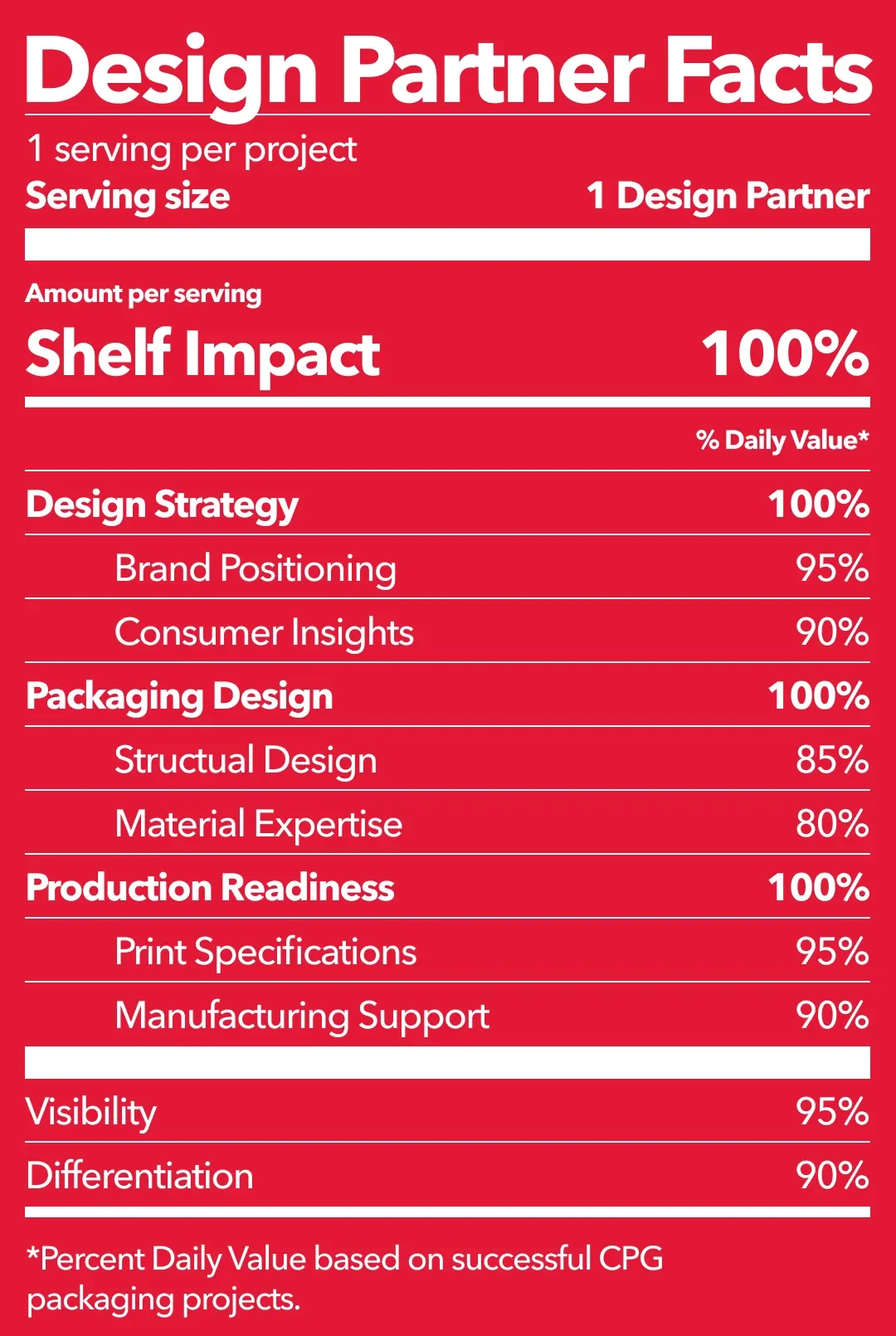
The Real Cost of Getting CPG Packaging Design Wrong
It’s easy to imagine what a good packaging design will bring you. However, it’s also worth spending a moment on what bad costs. For most small CPG brands, the math is unforgiving in ways that aren’t always obvious upfront.
- Reprints and Delayed Launches: Launch dates can be affected by a compliance error, a color mismatch, or a structural issue caught too late.
- Slow Velocity and Mid-Cycle Redesigns: Underperforming sell-through triggers a chain reaction of redesign, new photography, updated sell sheets, and revised listings. The cost adds up fast.
- Wrong Positioning, Wrong Shopper: A package that signals the wrong price tier or buries the key differentiator can quietly lose shoppers for months before anyone identifies why.
Wrapping It All Up
Choosing a creative design partner for your CPG packaging is one of the highest-leverage brand decisions you can make. It deserves the same rigor you’d apply to your formula, your pricing strategy, or your retail distribution plan. The brands that get it right aren’t always the ones with the deepest pockets. They’re the ones who asked harder questions before signing anything.
The right partner does not flinch at those questions; they are built to answer them. That’s how Roundhouse Partners operates.
Our creative team brings over 100 years of combined design experience across formats, industries, and retail environments. We’ve seen what moves product on the shelf, what falls apart in production, and what it takes to build a visual system that scales with your brand.
But here’s what actually sets us apart: we don’t hand off files and disappear.
Roundhouse is backed by creative experts who will work with you from the initial concept through print production and fulfillment. You’re assured that packaging, sales materials, sampling kits, and campaign assets all speak the same visual language because they’re built by the same team and guided by the same strategy.
If you’re a CPG brand evaluating design partners right now, we’d love to start with a conversation.
Get in touch with the Roundhouse team!
Frequently Asked Questions (FAQ)
-
What do creative design services for consumer goods packaging include?
At a minimum, they should cover visual identity applied to physical form, retail-ready compliance design, print production awareness, and shelf context strategy. -
How long does a CPG packaging design typically take?
A realistic timeline for a single SKU (from discovery through print-ready files) is 8–14 weeks with a serious partner. Brands that rush this phase by skipping proper discovery or compressing feedback rounds typically add time on the back end through revision cycles, compliance fixes, and production delays. -
Do I need a separate agency for packaging and for marketing materials?
Not if you choose the right partner. One of the most underappreciated advantages of working with a full-service creative partner is consistency. Your packaging, sell sheets, sampling kits, and campaign assets are all built from the same visual foundation by the same team. When those touchpoints are split across different vendors, inconsistency creeps in fast.