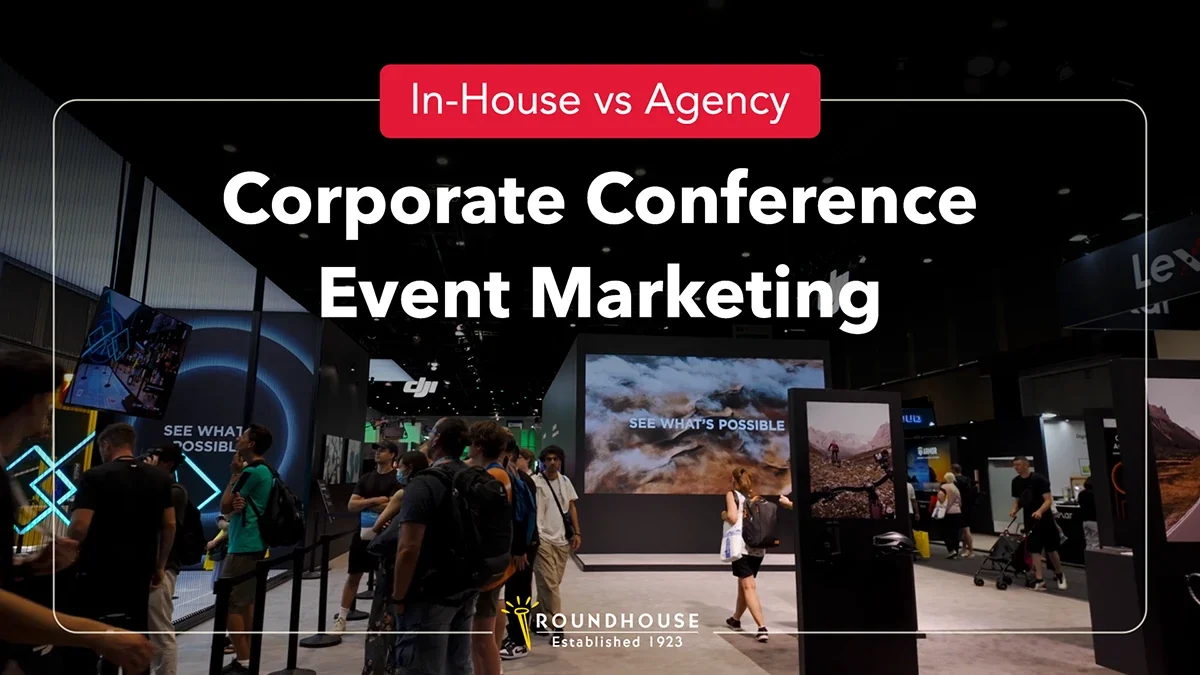
In-House vs Agency: Corporate Conference Event Marketing
Marketing leaders today are often put in a tough spot. They're fully accountable for conference results, but execution is left on a web of vendors they can't directly control. Tasks that seem simple on paper, like email promotions, social posts, and booth setups, quickly become complex once tied to shipping schedules and logistics. When even one element falls behind, the entire conference experience can feel disorganized.
This leads many businesses to the same question each time: Should corporate conference event marketing be handled in-house or managed by an agency?
The answer has less to do with creative capability and more to do with execution reliability. The real decision is about who can deliver consistent, coordinated execution when timelines are tight and expectations are high.
What is Corporate Conference Event Marketing?
Corporate conference event marketing is the strategic planning and execution of a company's presence at industry events. It's still one of the most effective ways to build brand visibility, relationships, and sales opportunities. In this context, marketing extends far beyond the event itself. It includes booths, signage, and printed materials, as well as email campaigns, social media promotion, event landing pages, and on-site engagement.
The Pressures of Corporate Conferences
In 2025, conferences and seminars account for 31.35% of all corporate events. With that level of volume, it's easy to assume most organizations already know how to run these events. In reality, even well-planned corporate events are vulnerable to breakdowns because of these common issues:
- Vendor Coordination Issues
- Missed deadlines
- Disconnected pre and post-event promotion
- On-site execution problems (damaged or missing assets, incorrect booth setups, etc.)
- Limited internal capacity
Many teams don't realize that these issues rarely happen in isolation. They're minor details that stack up and create unnecessary problems and put the overall success of the conference at risk.

Which Is Better: In-House or Agency?
In evaluating how to manage corporate conferences, other teams don't start with a list of pros and cons. They begin with assessing their current needs, internal capacity, and execution goals.
Teams that lean more towards in-house event marketing are usually:
- Businesses that want direct control over branding and messaging
- Organizations that already have a network of vendors and logistics
- Teams with dedicated staff for events and campaign coordination
- Companies with predictable conference schedules and timelines
- Organizations capable of handling execution risk internally
You'd probably appreciate agency-led event marketing if you are:
- A business with limited internal bandwidth
- Managing multiple events and complex campaigns all at once
- Seeking additional support for planning, promotion, or execution
- Lacking the materials, tools, or infrastructure to execute end-to-end
- Seeking guidance on navigating venue rules and event requirements
Even after identifying the right approach for conference marketing, it is worth noting that the in-house versus agency discussion applies across many areas of marketing. For a broader comparison beyond events, you can explore our detailed breakdown in In-House Marketing vs. Agency: The Pros and Cons.
Signs It May Be Time to Consider an Agency
Some teams have adapted a hybrid approach where they manage some aspects of corporate conference event marketing in-house, but rely on external help for others. Over time, this hybrid approach can start to feel inefficient, especially as conference demands increase.
You might want to consider agency support if:
- Conference planning starts pulling focus from higher-impact work
- Vendor coordination feels harder to keep organized
- Timelines don't allow much room to recover from potential delays
- Event logistics seem to rely on guessing rather than experience
- Managing booths, signage, and shipping becomes an ongoing frustration
Experiencing these challenges does not indicate underperformance. These factors just reflect that conference execution has outgrown your original setup. Recognizing this shift early gives teams the opportunity to reduce risk, stabilize execution, and approach future events with greater confidence.
Choosing The Right Support
The choice between an in-house and agency-led corporate conference event marketing comes down to how confident you are with the execution. Conferences leave little room for error because everything runs on tight timelines and strict guidelines.
In situations like these, success is often tied to having the right support in place. That means working with a partner who understands both the creative and logistical realities of events. With more than 102 years in business, Roundhouse has supported brands across a wide range of expos, tradeshows, and experiential campaigns by bringing structure, clarity, and reliability to event execution.
Our teams handle everything from creative production to on-the-ground logistics, allowing clients to stay focused on outcomes rather than troubleshooting. Over time, that consistency has become a defining part of how we work—approaching challenges with a practical, entrepreneurial mindset and meeting deadlines even when conditions are less than ideal.
If you want to approach your next conference with confidence, connect with us and let's start planning your next event!