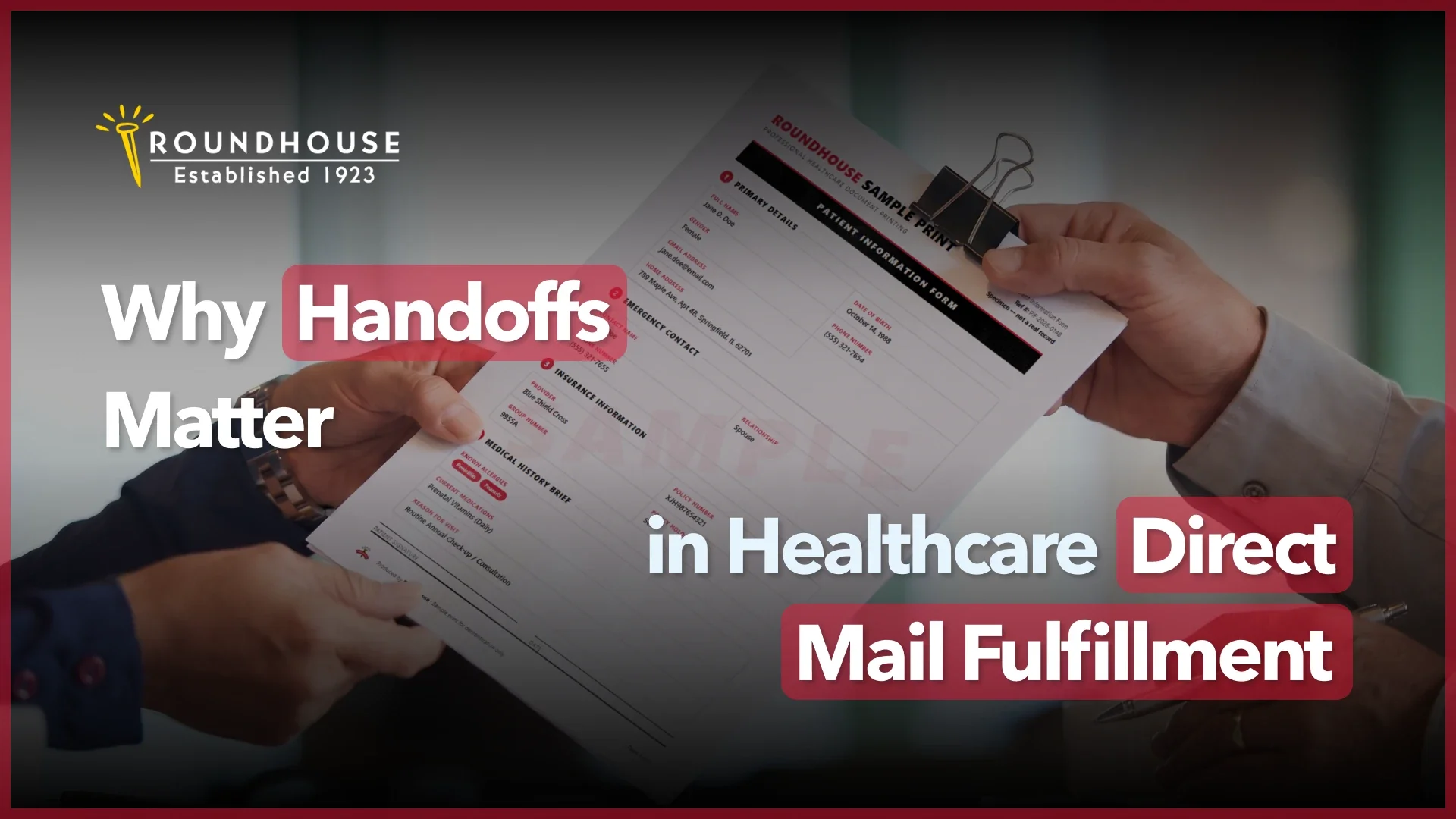
Why Handoffs Matter in Healthcare Direct Mail Fulfillment
Quick answer
The biggest risk in healthcare direct fulfillment isn’t the printing or the message. It’s usually what happens in between vendors that handle the list, print file, fulfillment, and the mail carrier. Every handoff is a point where a patient’s information can become mismatched, delayed, or mishandled. Fewer handoffs means fewer places for that to happen.
If you ask anyone in healthcare marketing what makes direct mail risky, you’ll get the same two answers: (1) patient health information needs to be protected, and (2) the message has to be personal. Both are true and talked about constantly but almost no one talks about what happens in between them.
Most healthcare mail doesn’t move through one company — it moves through several. A list provider handles the data, a printer produces the piece, a fulfillment house assembles and ships it, sometimes with a mail service layered on top. Individually, they do their part correctly. But every time something moves from one company to the next, there’s a new chance for something to slip through.
Why Handoffs Are Where Healthcare Mail Actually Breaks
In most print projects, a missed handoff equates to delays, reprints, or a few unhappy clients. In healthcare mail, you don’t get that kind of margin for error. The consequences are much higher.
When you’re handling patient statements, appointment reminders, lab result notifications, or any mail containing protected health information (PHI), even a small disconnect between teams can put sensitive information at risk. Even if only one version gets out of sync, you risk sending someone’s health information to the wrong place.
We covered the basics of PHI and HIPAA-compliant print and mail in our earlier guide. Here, we’re focusing on something more practical: the points in the process where handoffs tend to fail.
How a Handoff Can Turn Into a Risk
If you’re trying to figure out where your own process is most exposed, these are the four places to look first.
1. List Handoff to Print
A mailing list may be deduplicated, cleaned, and address-verified by one team, but that doesn’t always mean the same version makes it to print. If the print file is built from an older list, all that work becomes irrelevant. The data may be accurate, but it never makes it into the pieces that are actually mailed.
2. Print handoff to fulfillment
When printing and fulfillment happen at different facilities, finished pieces have to be packed, shipped, received, and checked in before fulfillment can begin. Every additional transfer creates another opportunity for delays, misplaced materials, or confusion over what belongs to which job. The longer the chain, the more chances there are for something to go wrong.
3. Fulfillment handoff to mail entry
Kitting only works when every piece ends up in the right envelope for the right recipient. That means the inserts, sequence, and mailing instructions all have to match the latest approved specifications. When different vendors are working from different files, you risk committing errors.
4. The account-ownership gap
If every part of the process is outsourced, that might mean no one really owns anything. Each team is responsible for only one piece of the job. If something looks wrong, it’s easy to assume another vendor already checked it. Each vendor is accountable for its own work, but not necessarily for what happens between handoffs.

What Changes When the Process Is Under One Roof
The most effective way to reduce a handoff risk is to reduce the number of handoffs.
That’s the entire idea behind how Roundhouse has run since 1923. List processing, printing, kitting, and fulfillment all happen in the same facility. Every part of the process uses the same files and is managed by the same team. Direct mail and kits are verified against the approved specifications before they leave the building. With no transit time between steps, standard kitting projects are typically completed within 24 to 48 hours of component availability.
We go deeper on why this structure matters (not just for speed but for accountability) in Single-Vendor vs. Multi-Vendor Printing: Which Costs You Less? and Integrated Printing and Logistics Benefits You Should Know.
Compliance Doesn’t Disappear Just Because It’s One Vendor
Reducing handoffs lowers the risk of errors, but it isn’t the only factor. Healthcare organizations should also look at how a print and mail provider handles protected health information (PHI), including secure data transfer, access controls, and documented procedures. The number of vendors involved matters, but so does how each one manages compliance.
At Roundhouse, that starts with a dedicated account manager or someone who understands your program’s specific requirements from the outset. They advise on mailpiece format and design with PHI handling built in from the start.
We cover those requirements in more detail in our HIPAA-compliant print and mail guide.
Where Personalization Fits Into This
None of this matters much if the piece that arrives isn’t relevant to the person receiving it. Getting the right mail to the right person, intact and on time, only pays off if it actually speaks to them. This means getting the right appointment, the right billing detail, the right next step. That’s the personalization side of healthcare mail, and it’s a different piece of the puzzle from fulfillment.
📌 There’s a separate piece on exactly that: How Variable Data Printing Keeps Patients Informed in Healthcare.
Frequently Asked Questions (FAQs)
-
What should I ask a potential provider about how they handle handoffs?
Start with how many facilities your project actually passes through. Then, check out who’s responsible for catching a mismatch if the list, the print file, and the fulfillment job ever fall out of sync. A provider who can give clear answers, without pointing to a different vendor, is telling you something important about how the rest of the process works too. -
What’s the difference between a fulfillment error and a compliance violation?
A fulfillment error is a mismatch, delay, or mistake in the physical process. It’s usually a wrong insert, wrong sequence, or a missed deadline. It becomes a compliance issue specifically when that error results in PHI being exposed to the wrong recipient. Not every fulfillment error rises to that level, but for healthcare mail, the margin for that distinction is thin. -
Is a single-vendor model realistic for a health system with multiple locations or departments ordering mail separately?
Yes, though it takes some upfront coordination. Different departments or locations can still submit their own mailing lists and requests. But with a single-vendor approach, everything routes through one account team and one production workflow instead of each department managing its own separate vendor relationship.
Healthcare direct mail doesn’t usually fail because someone printed the wrong thing. It fails in the space between the people responsible for getting it right. If you’re evaluating how your current process handles those handoffs, our team can walk through what that would look like for your program.