Experiential Marketing for CPG Brands: How Roundhouse Builds Activations
Quick answer
Experiential marketing for CPG (Consumer Packaged Goods) brands is an engagement strategy that lets customers see, try, or interact with a product in person. Common examples include product sampling at events, in-store demos, branded pop-up shops, and trade show booths. A CPG campaign may use one format or combine several, depending on the product, audience, and campaign goals.
Experiential marketing for CPG brands is any in-person activation, such as event sampling, in-store demos, pop-ups, mobile tours, or trade show booths, that lets consumers see, taste, or try a product before they buy it. It works because trial builds a stronger connection than a label claim, as long as the right product and materials arrive on time and in good condition.
Event Marketer's EventTrack 2026 study of more than 1,000 Fortune 1000 marketers and event attendees found that 61% of consumers said they were more inclined to purchase after an event. For CPG brands, this highlights the value of creating experiences that move consumers from simply encountering a product to considering purchasing it.
But creating that experience takes more than a great concept. The right products, packaging, displays, printed materials, promotional items, and other assets all need to arrive at the right place, at the right time, and in the right condition.
At Roundhouse, we've handled the physical side of marketing since 1923. Below, we cover why CPG activations are harder to execute than most events, how we build one step by step, which formats fit which products, and what two decades of supporting the Oscar Mayer Wienermobile has taught us.
New to the discipline? Start with our deep dive into event and experiential marketing.
Are CPG Activations Harder to Pull Off Than Other Events?
Consumer Packaged Goods (CPG) activations are more complex because they involve physical products that must be stored, packed, transported, and delivered under specific requirements. A software company may only need to ship a booth and printed materials, but a CPG brand needs to coordinate food, beverages, and event materials, all with different handling and delivery requirements.
Here are some of the most common challenges with CPG event activations:
- SKU Sprawl: Multiple flavors, sizes, varieties, or product configurations quickly multiply the number of items that need to be counted, packed, labeled, and tracked. Each event may also require a different product mix.
- Shelf Life and Temperature Requirements: Food, beverages, and other temperature-sensitive products can become unusable if exposed to unsuitable conditions during storage or transport.
- Venue and Retailer Requirements: Stores, arenas, convention centers, and other venues can have specific delivery windows, sampling requirements, receiving procedures, and documentation. Missing one requirement can delay an entire shipment.
- Sampling and Food-Safety Rules: Many retailers, venues, and local health departments set their own rules for serving food or beverage samples, including permits, portion sizes, and handling procedures. Those rules need to be confirmed for every location before kits are packed.
- Multiple Locations and Tight Timelines: A regional or national CPG campaign may involve dozens of activations happening within the same week, with each location requiring the right products and materials to arrive on schedule.
- Multiple Vendors and Handoff: When printing, packaging, warehousing, kitting, and shipping are handled by separate vendors, coordinating every step becomes more difficult. Each additional handoff creates another opportunity for an error, delay, or missing component.
This is why having more of the activation process managed under one roof can simplify execution. Fewer handoffs mean fewer chances for a kit to show up incomplete, late, or at the wrong dock.
If trade shows are your main focus, our guide to trade show kit fulfillment for CPG brands covers that side in more depth.
How Roundhouse Supports CPG Experiential Marketing
Every activation is different, but the path from the brief to the actual event follows the same steps. Each step depends on the one before it, which is why the order matters. At Roundhouse, each step is handled by one team, so our clients are not worried about anything getting lost between vendors.
Here's how our team takes an activation from the initial idea to the event floor:
- Set the goal and pick the format: We start with what the activation needs to do, whether it's driving trial or winning over retail buyers, then help you choose the format that fits.
- Create the event materials: Package and organize samples, promotional items, literature, and other materials needed for the activation.
- Print in-house: Inserts, coupons, displays, and large format pieces run on our own presses, so proofs and reprints don't wait on an outside shop.
- Receive and store the products: Products are counted by SKU and lot on arrival, and shelf-life dates are logged so each event receives product that's well within its shelf life. It's stored under the right conditions, including temperature control when needed.
- Kit and assemble. Samples, printed materials, and promotional items are packed into kits matched to each location's product mix.
- Ship and stage. Kits are timed to arrive inside each venue's receiving window, not days early, where they can sit on a loading dock or get misplaced.
- Set up and tear down. Our team can provide on-site installation and teardown, so your team can focus on the people at the event.
- Wrap up. Leftover product and materials come back, get recounted against what shipped, and return to storage, so you know what was used and what's ready for the next event.
Here's who handles what at each stage:
| Task | Client Responsibilities | Roundhouse Responsibilities | Roundhouse Service |
|---|---|---|---|
| Packaging, printed materials, and signage | Shares brand guidelines and approves proofs | Designs and prints sample packaging, inserts, coupons, displays, and large format signage in-house | Printing |
| Product storage and inventory | Ships product to our Verona, WI warehouse and shares shelf-life and storage needs | Receives your product, counts it by SKU and lot, and stores it until pack day | Warehousing |
| Kits and event supplies | Confirms quantities and flavors or sizes per event | Assembles and labels a kit for each location with the right SKU mix | Fulfillment |
| Branded Giveaways | Picks items and approves branding | Sources and packs promotional items into kits | Promotional Products |
| Delivery | Confirms venue contacts, dock times, and advance warehouse details | Ships to each venue's delivery window, with tracking, anywhere in the country | Trade Show & Event Marketing |
| Setup and Teardown | Confirms venue access and the event schedule | Provides on-site installation and teardown | Trade Show & Event Marketing |
That split keeps your team focused on the decisions only you can make, like product mix, branding, and venue contacts, while we handle the physical work in between.
Read more about how Roundhouse supports experiential marketing and the services we offer on our Event & Trade Show Marketing Services page.
CPG Experiential Marketing Example: Kraft Heinz and the Oscar Mayer Wienermobile
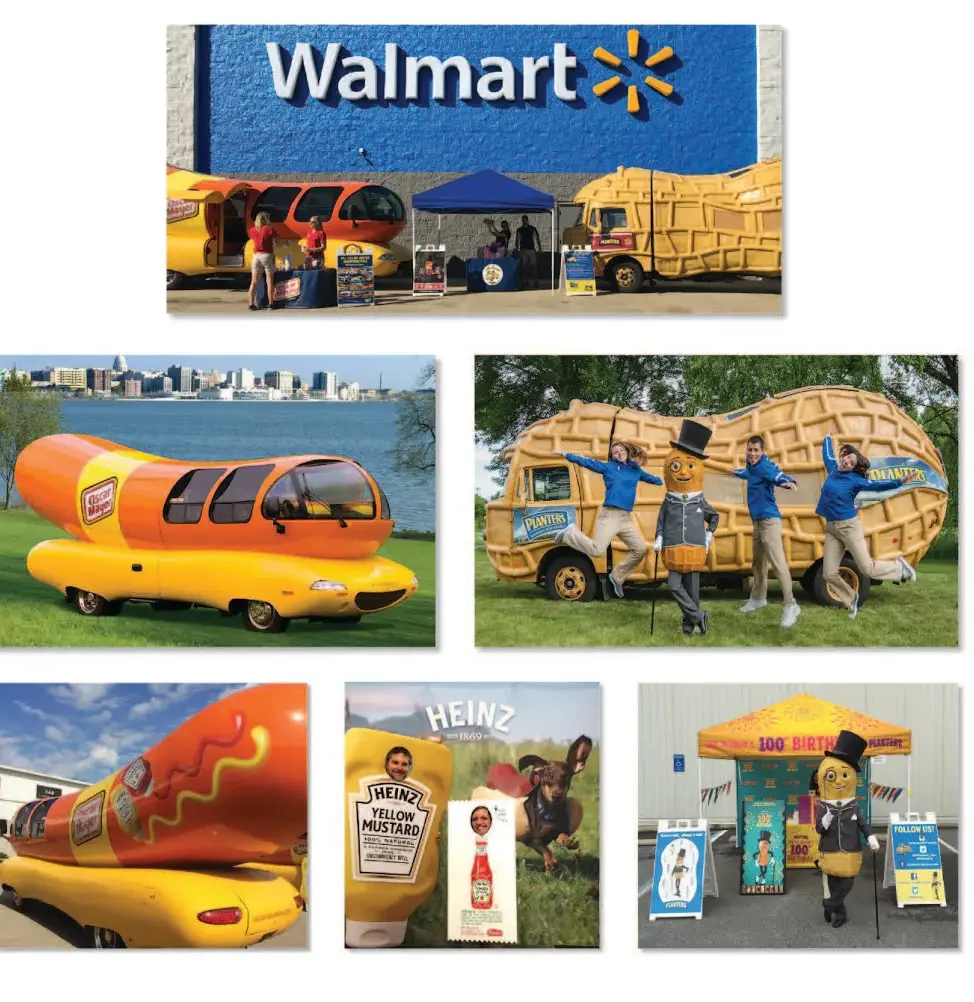
A look at more than 20 years of Roundhouse Partners, Inc.'s work supporting Kraft Heinz brand experiences.
The Oscar Mayer Wienermobile is a highly recognizable example of a CPG brand experience on the road. But running a mobile activation campaign across different locations requires more than the vehicle itself. Each stop needs the right tools, materials, and event supplies ready to go.
For more than 20 years, Roundhouse Partners has supported Kraft Heinz by keeping the Wienermobile fleet outfitted with the tools needed to create memorable event experiences. That work has expanded to include Planters and Heinz, helping take their brand shows on the road and support experiences that connect these products with consumers.
For a mobile CPG activation, the experience may happen on the road, but the work behind it starts long before the vehicle arrives.
Will Experiential Marketing Work for Every CPG Brand?
Experiential marketing can work for many types of CPG brands, but the right activation depends on the product, audience, buying behavior, and marketing goal. A product that benefits from sampling or demonstration may lend itself naturally to an in-person experience, while other products may need a different approach.
Here are some common activation formats and the CPG brands they fit best:
| Format | CPG Brands That Fit | Best For | Go Deeper (Related Readings) |
|---|---|---|---|
| Product Sampling | Food, beverage, snacks, personal care | Product trial and awareness | How Brands Win With Sampling Kit Services |
| Pop-Up Experiences | Food & beverage, beauty, wellness, lifestyle | Brand awareness and launches | The Power of Large Format Printing |
| Mobile Brand Tours | Food, beverage, snacks, household products | Multi-market campaigns and product launches | A Deep Dive into Event & Experiential Marketing |
| Retail Activations | Food, beverage, beauty, personal care, household | Product discovery and purchase consideration | Consumer Brand Point-of-Sale Print for Multi-Location Distribution |
| Trade Show & Event Activations | CPG manufacturers and consumer product brands | Product demonstrations and retail buyer relationships | From Warehouse to Show Floor: Trade Show Kit Fulfillment for CPG Brands How to Choose the Right Trade Show Booth Design Partner |
| Interactive Experiences | Beauty, wellness, lifestyle, technology-enabled products | Engagement, social sharing, and content creation | Marketing Execution Services for Live Events and Trade Shows |
Planning Your Next CPG Activation?
The best CPG activations may look effortless to the people experiencing them. Behind that is a lot of printing, packing, counting, and timing, and it all has to line up before the doors open.
From our facility in Verona, Wisconsin, Roundhouse Partners, Inc. handles that work for CPG brands across the country. It's the same team that has kept the Wienermobile fleet outfitted for Kraft Heinz for more than 20 years.
Tell us what you're planning, where it's happening, and when you need it ready. Talk to the Roundhouse team →
Frequently Asked Questions (FAQs)
-
What is experiential marketing for CPG brands?
Experiential marketing for CPG (Consumer Packaged Goods) brands is an engagement strategy that lets customers see, try, or interact with a product in person. Common examples include product sampling at events, in-store demos, branded pop-up shops, and trade show booths. A CPG campaign may use one format or combine several, depending on the product, audience, and campaign goals. -
What does Roundhouse do for CPG experiential marketing?
Roundhouse supports the physical execution of CPG activations, from creative and printing to packaging, kitting, warehousing, shipping, and event setup. By bringing these services together under one roof, Roundhouse helps brands coordinate the materials and logistics needed to get an activation ready for the event. -
How far in advance should a CPG brand plan an activation?
Work backward from the event date. CPG brands should start planning an activation at least 3 to 6 months in advance. Product sourcing, packaging, printing, kitting, shipping, and venue requirements can all affect the timeline. Starting early gives the team time to coordinate each part before the activation date, especially for multi-location or multi-SKU programs. -
How do you keep perishable products safe during an activation?
Products should be stored, packed, and shipped according to their handling and shelf-life requirements. At Roundhouse, we provide our clients with more than 10,000 square feet of environmentally controlled warehouse space for storing products and materials between activations. -
Can Roundhouse support CPG activations outside Wisconsin?
Yes. Roundhouse supports event and trade show marketing for brands across the country. From its facility in Verona, Wisconsin, the team provides services including printing, packaging, kitting, warehousing, shipping, and event setup to help coordinate activations in different locations.